Written by : Alen Vi | Creditcardviews.com
I still remember the look on Marco’s face. He was an international student from Italy, sitting in the corner of the campus library, his hands shaking so hard he couldn’t hold his phone. He had just moved to New York with two suitcases and a dream to study architecture. He was so proud when he got his first American credit card—it felt like a badge of belonging.
But he didn’t know about the student credit card scams USA 2026 lurking in his inbox. Like many credit card scams targeting students, it started with an “urgent” text about his tuition. Because he didn’t know how to avoid credit card scams USA, within 24 hours, his $5,000 savings—money his parents had saved for years—was gone. Seeing student credit card fraud examples like his is heartbreaking. That’s why I’ve put together these credit card safety tips for students. If you’re a first-time user or an international student, please read this. Your future depends on it.
Why Students Are Easy Targets for Credit Card Scams
Scammers aren’t just hackers in dark rooms; they are master psychologists. They know exactly which buttons to push to make a student panic. If you are new to the U.S., you are navigating a completely different financial system. You’re worried about your visa, your tuition, and your credit score. Scammers thrive on that fear and urgency.
Most students haven’t had a credit card before. You might not know that a bank will never ask for your PIN over the phone, or that the government doesn’t accept “clearance fees” via Zelle. Scammers use this lack of awareness as a doorway. They know you are busy, stressed, and perhaps a little lonely. They offer “help” that turns into a nightmare, often leading to student credit card fraud USA that can take months to resolve.
5 Student Credit Card Scams in the U.S. (2026)
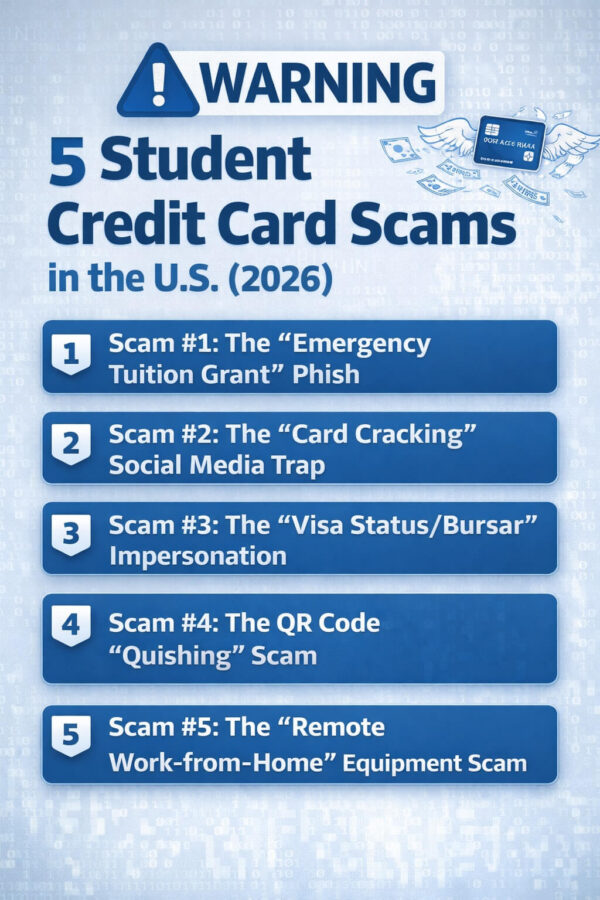
The world of fraud has changed. In 2026, scammers are using AI to mimic voices and deepfake official documents. Whether it is college credit card scams 2026 or identity theft, here are the five most dangerous traps you need to watch out for.
Scam #1: The “Emergency Tuition Grant” Phish
This is one of the most common credit card phishing scams students face right now. You receive an email that looks exactly like it’s from your university’s financial aid office. It says you’ve been selected for a “2026 Diversity Grant” of $2,000, but you need to pay a “processing fee” of $200 using your credit card to “verify your account.”
The Real-Life Story:
Priya, a graduate student, got this email. The logo was perfect. The link took her to a site that looked just like her student portal. She entered her credit card details for the $200 fee. Not only did she never get the grant, but the scammers used her card to buy $3,000 worth of electronics within an hour.
🚩 Red Flags
- The email comes from a personal address (like dept.edu@gmail.com) instead of a .edu address.
- The link in the email looks slightly “off” (e.g., university-portal.com instead of university.edu).
- They ask for an “upfront fee” to give you money.
💥 What Happens If You Fall for It
Your heart will drop the moment you see the “declined” notification at the grocery store. Beyond the lost money, your credit score can tank, making it impossible to rent an apartment or get a car loan later.
Scam #2: The “Card Cracking” Social Media Trap
You’re scrolling through Instagram or TikTok and see a “Student Wealth Coach” showing off a stack of cash. They claim they can “multiply” your money. All they need is your bank login or your credit card number to “run a legal loophole.”
The Real-Life Story:
Jordan saw a post saying, “Turn $500 into $5,000 in two days.” The person had 50,000 followers and lots of “thank you” comments (all fake). Jordan gave them his card info. The scammer deposited a fake check into Jordan’s account and spent the “available” funds immediately. When the bank realized the check was fake, Jordan was held responsible for the $5,000 debt.
🚩 Red Flags
- Offers of “guaranteed” or “easy” money.
- Someone asking for your bank password or card PIN.
- Testimonials that look too scripted or use the same photos.
💥 What Happens If You Fall for It
This isn’t just a scam; the bank might see you as a participant in student credit card fraud examples. They could close your account permanently and report you to the police for check fraud.
Scam #3: The “Visa Status/Bursar” Impersonation
This is the “Fear King” of scams. You get a phone call from someone claiming to be from “U.S. Citizenship and Immigration Services” (USCIS) or your University Bursar. They claim there is an error with your payment, and if you don’t pay a “fine” immediately via credit card, your visa will be revoked.
The Real-Life Story:
Imagine being 8,000 miles from home and someone tells you that you have 2 hours to pay $1,500 or you’ll be deported. That happened to Chen. He was so terrified he gave them his credit card number over the phone. He spent the next three days crying, too scared to even go to class.
🚩 Red Flags
- Calls from “government” agencies asking for money over the phone.
- Threats of immediate arrest or deportation.
- The caller insists you stay on the line while you pay.
💥 What Happens If You Fall for It
The emotional trauma is worse than the financial loss. You feel violated and unsafe in the country you worked so hard to get to.
Scam #4: The QR Code “Quishing” Scam
In 2026, everything on campus is a QR code. From laundry to dining hall menus. Scammers are now sticking “fake” QR codes over the real ones.
The Real-Life Story:
Sarah went to pay for her laundry by scanning the QR code on the machine. The site asked her to “re-enter” her credit card because of a “system update.” It was a fake site. The scammers didn’t just take her $2.50 for the laundry; they sold her credit card data on the dark web.
🚩 Red Flags
- A QR code that looks like a sticker placed over another code.
- The website the QR code takes you to looks blurry or has typos.
- Being asked for your full Social Security Number or birthdate just to pay for a small service.
💥 What Happens If You Fall for It
Your card gets “cloned.” You might not notice it for weeks until you see hundreds of small, strange charges from different states.
Scam #5: The “Remote Work-from-Home” Equipment Scam
Students are always looking for extra cash. You find a “Data Entry” job on a campus job board. They “hire” you instantly and send you a digital check to buy “office equipment” from their “approved vendor” using your credit card.
The Real-Life Story:
The “vendor” is just the scammer. You pay $2,000 for a laptop that never arrives. The check they sent you bounces. Now you owe the bank $2,000, and you still don’t have a job.
🚩 Red Flags
- Being hired without a video interview.
- Being asked to buy equipment from a specific website before you start.
- The pay is way too high for simple work (e.g., $40/hour for basic typing).
💥 What Happens If You Fall for It
You feel foolish and exploited. You spent your time and your money on a lie, leaving you even more broke than when you started.
Real Police-Reported Scam Cases (USA)
Case 1: The “Verification” Trap (Boston, MA)
A student at a major university reported losing $4,500 after a caller ID “spoofed” the local police department. The caller told the student their credit card was linked to a crime and they needed to “move the credit limit” to a safe account to “verify” their innocence. Lesson: The police will never ask you to move money or provide credit card numbers to prove you are innocent.
Case 2: The Social Media “Brand Ambassador” (Los Angeles, CA)
Several students were targeted by a fake clothing brand. They were told to pay a “shipping fee” for free clothes to promote. The website was a “data harvester” that stole their credit card info and used it to open dozens of new lines of credit in the students’ names. Lesson: If you have to pay to “work” for a brand, it’s a scam.
The $10 Billion Threat: What FTC Data Reveals About Student Fraud
The scale of this problem is staggering. According to recent data from the Federal Trade Commission (FTC), consumers in the U.S. reported losing more than $10 billion to fraud in a single year—a record-breaking high. Within this data, younger adults (ages 18–24) reported losing money to investment and credit card scams more often than any other age group. For international students, the stakes are even higher, as financial crimes are often underreported due to fear of visa repercussions. These aren’t just numbers on a spreadsheet; they represent thousands of students whose dreams were put on hold by a single fraudulent transaction.
How to Protect Yourself from Credit Card Scams
Protecting yourself isn’t just about being cynical; it’s about being prepared. Follow the advice of the experts:
Federal Trade Commission (FTC) Advice:
- Never Pay by Gift Card or Wire Transfer: If someone asks for a payment via a gift card, it is 100% a scam.
- Slow Down: Scammers want you to act fast. Stop. Think. Check with a friend.
FBI Guidance:
- Protect Your PII: Personally Identifiable Information (like your birthdate or SSN) is just as valuable as your card number. Never share it unless you initiated the contact.
Best Practices from the Big Banks
- Chase Bank: Use “Card Alerts.” You get a text the second your card is used. If you didn’t buy that $500 jacket in Vegas, you can stop it instantly.
- Bank of America: Use their mobile app to “Lock” your card when you aren’t using it.
- Citibank: Always use a “Virtual Account Number” for online shopping. This creates a fake card number that only works for one store.
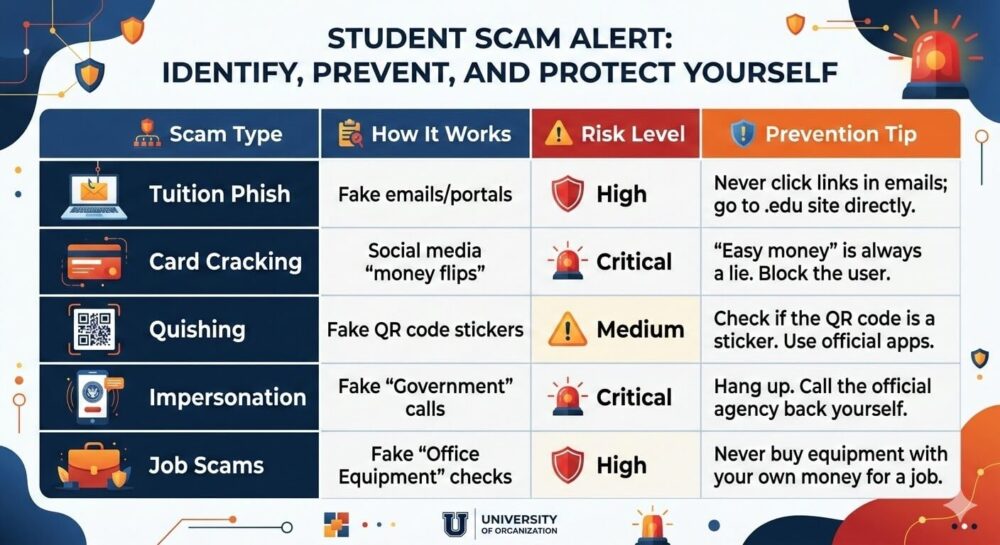
Comparison Table: Scam Type vs. Risk
Student Safety Checklist (Quick Chart)
- [ ] Set up Bank Alerts: Do this TODAY on your banking app.
- [ ] Use Multi-Factor Authentication (MFA): Ensure you need a code from your phone to log in.
- [ ] Check the URL: Look for the “Lock” icon and https://.
- [ ] Never share codes: If someone asks for a “verification code” sent to your phone, they are trying to hack you.
- [ ] Trust your gut: If it feels too good to be true, it probably is.
FAQs : Questions Every Student Asks
1. What should I do if my credit card is hacked?
Call your bank immediately to cancel the card and report the fraud.
2. Can students get money back after fraud?
If you report it quickly, most U.S. banks have “Zero Liability” policies for unauthorized charges. However, if you sent the money via Zelle or Wire, it’s much harder to get back.
3. Should I report to the bank or police first?
The bank first (to stop the bleeding), then the police/FTC (to document the crime).
4. Will a scam affect my U.S. visa?
Being a victim of a scam will not hurt your visa status. However, being involved in “Card Cracking” might.
5. How do I know if a call is really from my bank?
Hang up. Look at the back of your credit card. Call that number.
6. Why did the scammer know my name?
Your info is often sold in data breaches from other websites. It doesn’t mean they are official.
7. Can I trust campus flyers?
Not always. Scammers often pin “Work from Home” flyers on campus boards.
8. What is a “Chargeback”?
It’s a request to your bank to reverse a transaction. It’s a powerful tool for victims.
9. Are “Credit Repair” services for students legitimate?
Most are scams. You can build your credit for free by just paying your bills on time.
10. Is it safe to use public campus Wi-Fi for banking?
No. Use a VPN or your phone’s data hotspot.
What To Do If You Are Scammed
If you’re reading this and realizing you’ve already been hit—take a deep breath. You are not alone, and you are not “stupid.” These people are professionals.
1. Contact your bank immediately: Tell them “I am a victim of fraud.”
2. Freeze your card: Do this through your app while you are on hold with the bank.
3. Change your passwords: Not just your bank password, but your email too.
4. Report to the Federal Trade Commission (FTC): Visit ReportFraud.ftc.gov.
5. Report to the FBI (IC3): If it happened online, go to ic3.gov.
6. Talk to your International Student Office: They can help you navigate the emotional and legal stress.
Fraud Report Letter Draft to Your Bank
[Your Name] [Your U.S. Address] [City, State, Zip Code] [Your Phone Number] [Your Email]
[Date]
[Name of Bank/Credit Card Company] Attn: Billing Inquiries / Fraud Department [Bank’s Address] [City, State, Zip Code]
RE: Notice of Disputed/Fraudulent Charge to Account No. [Your Last 4 Digits]
Dear Fraud Department,
I am writing to formally dispute a fraudulent charge that appeared on my account statement. I am a student at [Your University Name], and I did not authorize this transaction. I believe I have been a victim of a scam.
Details of the Fraudulent Charge:
- Transaction Date: [Date]
- Transaction Amount: $[Amount]
- Merchant Name: [Name on statement]
I have already reported this via your customer service line and filed a report with the FTC. I am requesting that you investigate this matter and remove this charge from my account.
Sincerely,
[Your Signature]
[Your Printed Name]
Best Student Credit Cards to Build Credit in the U.S.
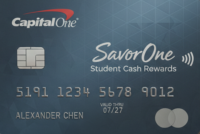
1. Capital One Savor Student Cash Rewards
Credit Card Views Rating: 9.7/10
- Best For: Students with active social lives and foodies.
- Fees: $0 Annual Fee | 0% Foreign Transaction Fee | Up to $40 Late Fee.
| Pros | Cons |
| High Rewards: 3% back on dining, entertainment, and groceries. | Credit Requirements: Often requires “Fair” credit (some history helps). |
| Travel Friendly: No fees for using it outside the U.S. | High APR: Carrying a balance is very expensive (up to 29.99%). |
| Easy Bonus: $50 bonus after spending just $100. | Store Exclusions: 3% grocery rate excludes Walmart and Target. |

2. Discover it® Student Cash Back
Credit Card Views Rating: 9.5/10
- Best For: Maximizing cash back through rewards matching.
- Fees: $0 Annual Fee | 0% Foreign Transaction Fee | $0 first late fee ($41 after).
| Pros | Cons |
| Cashback Match: Discover doubles all rewards earned in Year 1. | Activation Required: You must manually “turn on” the 5% categories. |
| Accessibility: No credit history required to apply. | Acceptance: Can be harder to use at small shops outside the U.S. |
| 5% Categories: High rewards on rotating essentials like gas/Amazon. | Spending Caps: 5% rate is capped at $1,500 in spending per quarter. |
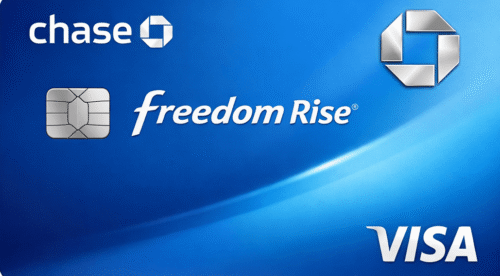
3. Chase Freedom Rise®
Credit Card Views Rating: 9.2/10
- Best For: Building a path into the Chase Sapphire ecosystem.
- Fees: $0 Annual Fee | 3% Foreign Transaction Fee | Up to $40 Late Fee.
| Pros | Cons |
| Simplicity: Flat 1.5% cash back on everything; no categories. | Expensive Abroad: The 3% fee makes it poor for international trips. |
| High Approval Odds: Easy to get if you have $250 in a Chase account. | Banking Dependency: Best results require an existing Chase relationship. |
| Upgrade Path: Easiest way to “graduate” to premium Chase cards. | Low Initial Bonus: Only a $25 credit for setting up Autopay. |
4. Deserve EDU Mastercard
Credit Card Views Rating: 9.0/10
- Best For: International students with no SSN or ITIN.
- Fees: $0 Annual Fee | 0% Foreign Transaction Fee | Up to $25 Late Fee.
| Pros | Cons |
| Passport Friendly: Apply with just your Passport, Visa, and I-20. | Low Base Rewards: Only 1% cash back on all purchases. |
| Amazon Perk: 1 year of Amazon Prime Student (after spending $500). | Lower Limits: Starting credit limits are often quite low ($300–$500). |
| Cell Phone Protection: Up to $600 in coverage for your phone. | Tech Experience: App and customer service are less robust than big banks. |
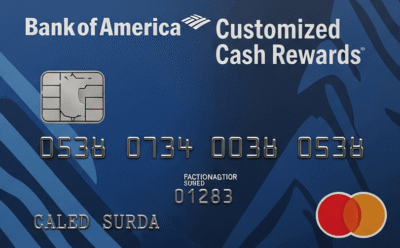
5. Bank of America® Customized Cash Rewards for Students
Credit Card Views Rating: 9.1/10
- Best For: Students with high spending in one specific area (like Online Shopping).
- Fees: $0 Annual Fee | 3% Foreign Transaction Fee | Up to $40 Late Fee.
| Pros | Cons |
| High Sign-up Bonus: $200 bonus (after spending $1,000)—best in class. | Reward Caps: 3% and 2% rewards are shared under a $2,500/quarter cap. |
| Customizable: Choose your 3% category (Online Shopping, Dining, etc.). | SSN Hurdles: Without an SSN, you usually must apply in person at a branch. |
| Intro APR: 15 billing cycles of 0% interest on purchases. | Foreign Fees: Not suitable for use outside of the United States. |
Conclusion
Coming to the U.S. as a student is an act of bravery. You are building a life in a new place, and that is incredible. Don’t let a scammer take that away from you. By staying alert to student credit card scams USA 2026, you are protecting more than just your money—you are protecting your peace of mind and your future.
Be the student who pauses. Be the student who asks questions. Be the student who “protects the bag.” You’ve worked too hard to get here to let a fake text message steal your dream. Stay safe out there. “One wrong click can cost your entire semester’s savings.
-END-
About the Author – Alen Vi
Alen Vi is a seasoned financial expert with over 10 years of experience specializing in the credit card industry. Throughout his career, he has worked with various leading media firms, providing in-depth analysis, insights, and guidance on personal finance, credit card rewards, and smart spending strategies. At Credit Card Views, Alen combines his extensive knowledge and practical expertise to help readers make informed decisions, maximize their cash back and rewards, and navigate the complex world of credit cards with confidence.
Disclaimer
The information provided on Credit Card Views is for general informational and educational purposes only and is not intended as financial, legal, or professional advice. While we strive to provide accurate and up-to-date information about credit cards, rewards programs, fees, and offers, terms and conditions can change frequently, and we cannot guarantee the accuracy, completeness, or timeliness of all content.
Credit card offers and eligibility criteria vary by issuer, credit score, and individual circumstances. Before applying for any credit card or making financial decisions, readers should conduct their own research and consider consulting with a qualified financial advisor.
Trust & Affiliate Disclosure
CreditCardViews.com provides independent and expert guidance to help you make informed credit card and financial decisions. Some links on this site are affiliate links. If you make a purchase through them, we may receive a small commission at no extra cost to you. Our recommendations are always based on research, user feedback, and expert analysis, and are not influenced by our partners. CreditCardViews.com does not issue credit cards or provide financial products directly. Final approval decisions are made solely by the issuing banks. Your trust and financial well-being are our top priority. Our platform uses SSL encryption and follows FTC, GDPR, and CCPA standards to provide secure, unbiased, and transparent credit card insights.