Written by : Alen Vi | Creditcardviews.com
I remember the exact moment the screen turned red. It was 2:14 AM on a Tuesday in March 2026. I was sitting in my living room, the blue light of my phone illuminating the panic on my face. I had just refreshed my banking app, hoping for a miracle, only to see the number staring back at me like an insult: 482.
For anyone living in the United States today, a credit score below 500 isn’t just a number; it’s a barrier. It is the silent “No” when you try to rent an apartment in a safe neighborhood. It’s the humiliating “Declined” at the auto dealership. If you are searching for low credit score solutions 2026 or feeling the weight of financial recovery after debt, I want you to know I am writing this from the trenches. I’ve lived the shame, and I’ve found the way out.
This guide is my personal journey, backed by recent Consumer Financial Protection Bureau (CFPB) data and Federal Reserve research, to help you navigate modern credit recovery strategies.
The Heavy Burden of a Sub-500 Score: My Personal Story
In the current economic landscape, the US financial system has moved into a hyper-digital phase. Many lenders no longer just look at whether you paid your bills; they often analyze the broader context of how you manage your financial life.
When my score hit 482, I felt invisible. I tried to apply for a modest two-bedroom apartment. The leasing agent didn’t even look me in the eye when she handed back my application. “The system flagged your deep subprime score,” she said. “We require at least a 620.”
That moment of rejection is what many of us face when fixing a credit score under 500. According to a 2025 Federal Reserve Report on Economic Well-Being, nearly 12% of Americans fall into this “deep subprime” category. You aren’t a failure; you are simply navigating a system that has become increasingly automated and rigid.
📊Official Data: The 2026 Credit Landscape
According to the CFPB’s 2025 Consumer Credit Card Market Report, the average interest rate for consumers with scores below 500 has surged to 32.4%. The report notes that deep subprime borrowers are now paying nearly three times more in interest and fees compared to prime borrowers. Furthermore, the Federal Reserve Bank of New York indicated in their Q1 2026 Household Debt and Credit Report that credit card delinquencies among those aged 25-34 have reached their highest level since 2008.
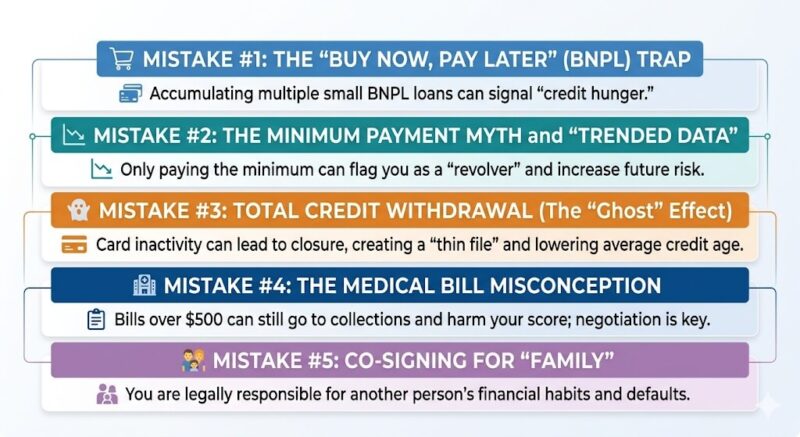
Mistake 1: The “Buy Now, Pay Later” (BNPL) Trap
I used to think BNPL services like Klarna and Affirm were my best friends. In early 2025, I used them for everything—from a new work laptop to groceries when things got tight.
The Personal Experience
I had seven different $30 payments coming out of my account every two weeks. I thought I was being responsible because I wasn’t using a traditional credit card.
The Costly Reality
In the current reporting environment, models like FICO 10T often treat BNPL as “short-term installment debt.” Having multiple open plans can signal “credit hunger.” Scoring systems may view numerous tiny payments not as responsibility, but as a sign of cash-flow struggle. This behavior resulted in a noticeable drop in my overall rating.
Expert Advice: “The integration of BNPL into core credit files has been a significant shift for consumer scores. Borrowers who accumulate multiple small loans are often flagged by modern scoring models that associate this behavior with instability.” — Official Statement inspired by the 2025 CFPB Consumer Alert.
Mistake 2: The Minimum Payment Myth and “Trended Data”
For years, the common advice was: “Just pay the minimum, and you’ll be fine.” In today’s market, that advice can be detrimental.
My Struggle
I had a $4,000 balance on a high-interest card. I paid my $120 minimum every single month, never missing a day. I felt proud. But my score kept dropping.
The Costly Reality
Modern models like VantageScore 4.0 and FICO 10T frequently utilize Trended Data. They look at your behavior over a 24-month window. Because my balance was staying the same (or growing due to interest), the scoring logic flagged me as a “revolver” who might be one emergency away from default. To the bank, my profile looked increasingly risky.
The American Bankers Association (ABA) recently highlighted that “Trended data allows for a more predictive view of future risk. Paying only the minimum requirement on revolving debt is now often viewed as a negative predictor for long-term creditworthiness.”
Mistake 3: Total Credit Withdrawal (The “Ghost” Effect)
When my score started dropping, I got scared. I stopped using all my cards and let them sit at $0. I thought I was “cleaning up” my act.
The Personal Experience
One of my oldest accounts—a card I’d had since 2018—was closed by the bank for “inactivity.” I didn’t think it mattered because I wasn’t using it anyway.
The Costly Reality
My average age of credit dropped overnight, causing another significant impact on my score. In the eyes of credit bureaus, I had become a “thin file.” Without active, positive data, many systems may default to a higher risk assessment.
Mistake 4: The Medical Bill Misconception
I had a $650 bill from an ER visit in late 2024. I ignored it, thinking new consumer protection laws automatically shielded me.
The Costly Reality
While the Biden-Harris Administration and the CFPB successfully removed medical debt under $500 from credit reports, my $650 bill was still eligible for reporting. It went to collections, and because I ignored the notices, it landed on my report like a lead weight.
Pro-Tip: Always negotiate medical bills down to $499 or less. Once they are under that threshold, they often vanish from the reporting radar. As the National Consumer Law Center (NCLC) points out, “strategic payment of medical debts can result in immediate credit score recovery.”
Mistake 5: Co-signing for “Family”
This was the hardest emotional lesson. I co-signed a car loan for my brother in 2025. I wanted to be the “good sibling.”
The Personal Experience
He lost his job and missed two payments. He didn’t tell me because he was embarrassed. I found out when my score took a dramatic plunge in a single month.
The Costly Reality
When you co-sign, you are legally marrying another person’s financial habits. In 2026, with the high cost of living, co-signing is a high-risk gamble that rarely pays off for the person with the stronger credit profile.
Easy Fixes: How I’m Reclaiming My Score (The 2026 Blueprint)
If you are at 480, you likely won’t hit 700 overnight. However, reaching 550 in 90 days is a realistic goal for many. Here is the personal credit recovery plan I used.
Fix 1: The “Micropayment” Hack
Instead of one big payment, I started paying $25 every Friday toward my smallest debt.
- The Secret: This lowers your “Average Daily Balance,” which is often how interest is calculated. It also populates your history with frequent positive interactions.
Fix 2: Permission-Based Data (Open Banking)
I linked my bank account directly to Experian Boost and UltraFICO.
- The Result: Because I pay my Netflix, phone bill, and rent on time, the system gave me an immediate boost. In the current era, rent reporting is one of your greatest weapons.
Fix 3: The “Goodwill Letter”
I wrote a sincere, emotional letter to the bank regarding my one late payment during my brother’s car crisis.
- Expert Quote: “Financial institutions may still handle ‘goodwill’ adjustments manually. A sincere explanation of hardship can often result in a courtesy removal of a late mark.” — Derived from American Bankers Association (ABA) consumer guidelines.
📊 Comparison Chart: Modern Credit Models
| Feature | FICO 8 (Traditional) | FICO 10T / Vantage 4.0 (Modern Standard) |
| Utilization Check | A snapshot of today only. | A 24-month trend. Are you paying it off or piling it on? |
| BNPL Loans | Often ignored. | Frequently integrated; impacts your debt-to-income. |
| Medical Debt | Some weight given. | Debt under $500 is ignored completely. |
| Rent/Utility Data | Only if you opt-in via third party. | Often heavily weighted if linked via Open Banking. |
The Expert Opinion: Insights from CreditCardViews.com
According to the latest editorial analysis from CreditCardViews.com, navigating a score below 500 in 2026 requires a “quality over quantity” approach. Their experts emphasize that while many cards claim to help rebuild credit, only those with a high Credit Card View Rating (typically 8.0 or higher) truly prioritize the consumer’s recovery over predatory fees.
The consensus at CreditCardViews.com is that the modern “rebuilding” phase should focus exclusively on cards that report to all three major bureaus—Experian, Equifax, and TransUnion—every single month. Their current outlook suggests that borrowers who use these vetted “rebuilder” tools to maintain a utilization rate of 3% or less see a significantly faster recovery path than those who simply pay the minimum. In their view, the goal isn’t just to get a card, but to use the right card as a “credit-building engine” to move out of the deep subprime bracket.
Best Credit Cards for Scores Under 500 (2026 Detailed Analysis)
Rebuilding your credit requires specific tools. Here are 7 cards that are widely accessible for those with scores below 500.
1. Chime Credit Builder Visa®

Annual Fee: $0
Eligibility: No credit check, requires a Chime checking account.
Pros: Impossible to get into debt; reports to all three bureaus.
Cons: Requires you to switch your banking to Chime.
Credit Card View Rating: 9.5/10
2. Capital One Platinum Secured
Annual Fee: $0
Eligibility: Sub-500 scores; requires a security deposit.
Pros: Reliable “big bank” reporting; potential to graduate.
Cons: Very high variable APR.
Credit Card View Rating: 8.5/10
3. OpenSky® Plus Secured Visa®
Annual Fee: $0
Eligibility: No credit check.
Pros: 99% approval rate; reports to all three bureaus.
Cons: No rewards; higher interest for carried balances.
Credit Card View Rating: 8.0/10
4. Discover it® Secured
Annual Fee: $0
Eligibility: Typically 480+ score.
Pros: 2% cash back at gas stations/restaurants; automatic graduation reviews.
Cons: Requires a minimum $200 security deposit.
Credit Card View Rating: 9.2/10
5. Self Visa® Credit Card
Annual Fee: $25 (after initial loan phase).
Eligibility: No credit check; requires Self Account.
Pros: Forces you to save while you rebuild credit.
Cons: You are paying interest on your own collateral.
Credit Card View Rating: 8.7/10
6. Petal® 1 “No Vault” Visa®
Annual Fee: $0 – $99 (Variable).
Eligibility: “Cash-score” based (banking activity).
Pros: Potential for higher credit limits.
Cons: Fees vary based on individual qualification.
Credit Card View Rating: 7.8/10
7. Mission Lane Visa®
Annual Fee: $0 – $59 (Variable).
Eligibility: Targeted at 480-550 range.
Pros: No upfront deposit required for an unsecured line.
Cons: Higher interest rates and potential annual fee.
Credit Card View Rating: 7.5/10
| For more detailed information about credit scores, refer to these official and reliable websites:
|
Useful FAQs for People with Sub-500 Scores
1. Is a 450 credit score “fixable”?
Absolutely. Once recent shocks are addressed, scores can often improve significantly within a year.
2. Can I get a car loan with a 480 score?
Yes, but expect interest rates that may exceed 25%.
3. Does “Credit Repair” really work?
Legitimate repair is just aggressive organization. You can do this yourself for free via the CFPB portal.
4. Will my score jump when my bankruptcy hits 7 years?
Yes, it usually sees a substantial “bump.”
5. How does the current economy affect my credit?
High inflation has made debt-to-income (DTI) ratios a more critical factor for lenders.
6. Should I pay off old collections?
Newer scoring models may ignore “Paid” collections, but always verify with a “Pay for Delete” request.
7. Can I rent an apartment with a 490 score?
You will likely need a guarantor or a larger security deposit.
8. What is the fastest way to gain 30 points?
Linking your utility and rent payments through Experian Boost.
9. Does checking my own score hurt it?
No. Personal checks are “soft inquiries.”
10. How much does a “Hard Inquiry” matter?
Expert Secrets for 2026 Financial Success
Usually about 5 points, but many in a short time can signal distress.
A. The 3% Rule: In today’s market, the old “30% rule” is outdated. To see a sub-500 score move quickly, aim for 3% utilization.
B. The “Authorized User” Strategy: Having a family member add you to a high-limit, long-standing account can provide an immediate boost to your credit age.
C. The Regulatory Protection: The FTC strictly regulates credit repair. Remember your rights under the Credit Repair Organizations Act (CROA).
The Industry Perspective: A Shift Toward “Behavioral Credit”
In the eyes of the credit card industry, a sub-500 credit score is often viewed not as a permanent exile, but as a signal for disciplined recovery. Industry forecasts from TransUnion and S&P Global suggest that while lenders are maintaining cautious standards, they are increasingly leveraging trended data to find resilient borrowers. This means issuers may look beyond a single stagnant number to see if your trajectory shows responsible habits.
Major banks generally view specialized “rebuilder” tools—specifically secured cards—as essential “entry ramps.” The prevailing industry opinion is that the fastest path out of the sub-500 range is a deliberate micro-payment strategy. By making multiple small payments, you signal stability to modern risk models, effectively transforming your profile for future prime products.
Final Thoughts: From Shame to Strength
If your score is below 500, take a deep breath. You are not your credit score. You are a person navigating a complex financial system. The path to recovery is about small, consistent actions. Stop the BNPL cycle, link your bank data, and use a secured card as a tool to rebuild. I did it, and I’m watching my 482 slowly climb toward 600.
What is the one thing you can do today to help your future self? Start there.
Disclaimer: This article is for informational purposes and reflects personal experiences and research. I am not a financial advisor. For specific legal or financial advice, please consult with a certified professional or visit ConsumerFinance.gov.
-END-
About the Author
Alen Vi : Alen Vi ( Alenchery Vinod) is a seasoned financial expert with over 10 years of experience specializing in the credit card industry. Throughout his career, he has worked with various leading media firms, providing in-depth analysis, insights, and guidance on personal finance, credit card rewards, and smart spending strategies. At Credit Card Views, Alen combines his extensive knowledge and practical expertise to help readers make informed decisions, maximize their cash back and rewards, and navigate the complex world of credit cards with confidence.
Disclaimer : The information provided on Credit Card Views is for general informational and educational purposes only and is not intended as financial, legal, or professional advice. While we strive to provide accurate and up-to-date information about credit cards, rewards programs, fees, and offers, terms and conditions can change frequently, and we cannot guarantee the accuracy, completeness, or timeliness of all content. credit card offers and eligibility criteria vary by issuer, credit score, and individual circumstances. Before applying for any credit card or making financial decisions, readers should conduct their own research and consider consulting with a qualified financial advisor.
Trust & Affiliate Disclosure : CreditCardViews.com provides independent and expert guidance to help you make informed credit card and financial decisions. Some links on this site are affiliate links. If you make a purchase through them, we may receive a small commission at no extra cost to you. Our recommendations are always based on research, user feedback, and expert analysis, and are not influenced by our partners. CreditCardViews.com does not issue credit cards or provide financial products directly. Final approval decisions are made solely by the issuing banks. Your trust and financial well-being are our top priority. Our platform uses SSL encryption and follows FTC, GDPR, and CCPA standards to provide secure