Written by : Alen vi
Edited by : Credit card views Desk
Landing at a US airport for the first time is a rush of adrenaline. You have your I-20, your visa, and a suitcase full of dreams. But then, you try to rent an apartment, set up a phone plan, or even just buy a desk from IKEA, and you hit a wall: The Credit Wall.
For many international students, the US credit system feels like an “invitation-only” club where you need a history to get a card, but you need a card to get a history. It is a frustrating, emotional cycle that can make you feel like a “financial ghost” in a country built on plastic.
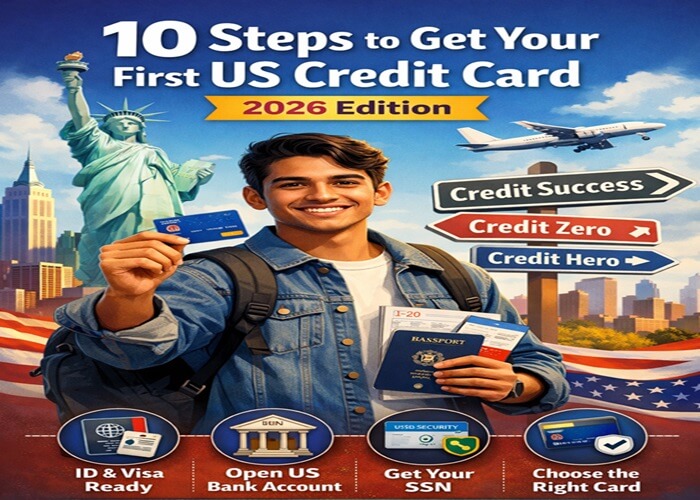
If you are an F-1, J-1, or M-1 student, don’t panic. Getting your first US credit card is not just possible—it is a strategic rite of passage. This pillar guide breaks down the 10 essential steps to go from “Credit Zero” to “Credit Hero” without the stress.
The State of International Students in the US (2026 Data)
Before we dive into the steps, let’s look at why you are a vital part of the US economy. You aren’t just a student; you are a high-value consumer that banks want to attract, even if their old systems make it hard.
International Student Enrollment Data
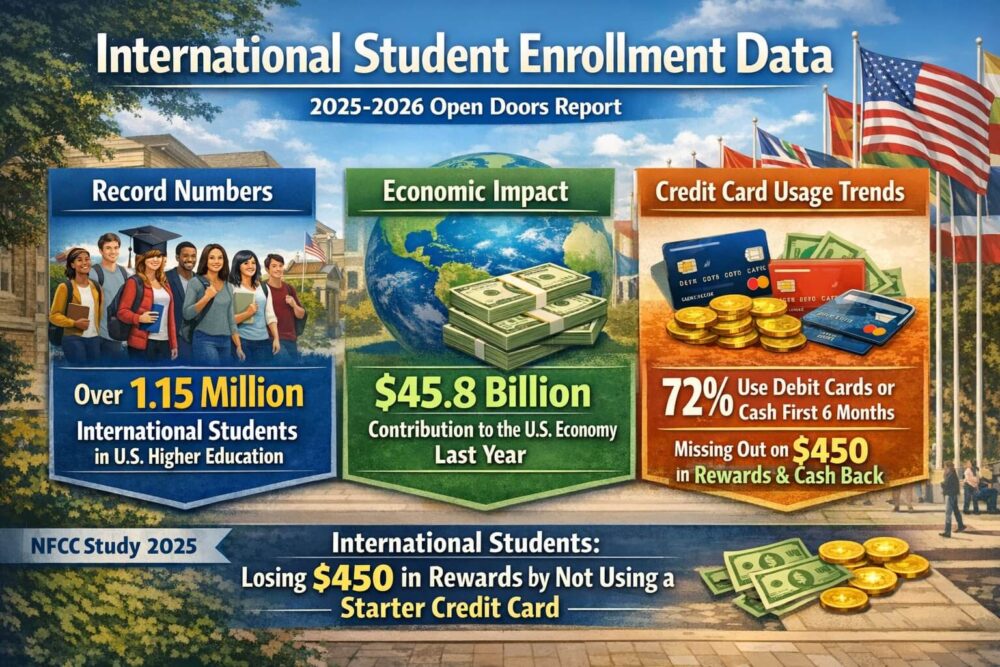
According to the latest 2025-2026 Open Doors Report and supplemental census data:
- Record Numbers: Over 1.15 million international students are currently enrolled in US higher education.
- Economic Impact: International students contributed a staggering $45.8 billion to the US economy in the last academic year alone.
- Credit Card Usage Trends: A 2025 study by the National Foundation for Credit Counseling (NFCC) found that 72% of international students rely on debit cards or cash for their first six months, losing out on an average of $450 in rewards and cash back they could have earned with a starter credit card.
The “Credit Gap” Problem
Research shows that 64% of international students are rejected for their first credit card application simply because the bank’s automated system cannot find a Social Security Number (SSN) or a domestic credit file. This “Credit Gap” is what we are going to bridge today.
The Emotional Journey: From “Rejected” to “Approved”
Before we dive into the mechanics, let’s acknowledge the feeling. Being an international student is hard enough. When a bank teller looks at your application and says, “Sorry, you have no record,” it feels personal. It feels like you don’t belong.
Feedback from the Student Community:
“I remember my first week in Chicago. I tried to get a basic card from a big bank, and they treated me like I was asking for a million-dollar loan. I felt so small. I didn’t realize I just didn’t have the right ‘data footprint’ yet.” — Ananya R., NYU Graduate Student.
This guide is designed to remove that sting. By following these steps, you aren’t just applying for a card; you are building your American financial identity.
10 Must-Do Steps to Get a First US Credit Card
Step 1: Secure Your “Identity Foundation” (Passport & Visa)
Before you even think about a bank, you need your paperwork in order. For the US financial system, you are your documents.
- Your Passport: Ensure it is valid for at least six months.
- Your I-20 or DS-2019: This proves your legal status and the duration of your stay.
- Proof of Residence: Banks need to see a US utility bill, a lease agreement, or a letter from your university housing office.
Pro Tip: Even if you don’t have an SSN yet, your passport and I-20 are your primary keys to opening a Student Checking Account, which is the “front door” to a credit card.
Step 2: Understand the “No-SSN” Hurdles
One of the biggest myths is: “You cannot get a credit card without a Social Security Number (SSN).” This is false.
While many traditional cards require an SSN, several “International Student Friendly” issuers allow you to apply using your Passport and I-20 or an Individual Taxpayer Identification Number (ITIN).
Why the SSN Matters to Banks
The SSN is essentially your “ID tag” for the three major credit bureaus: Experian, TransUnion, and Equifax. Without it, banks find it harder to track your behavior. However, in 2026, fintech companies have become much smarter at using “Alternative Data” (like your education history or bank balances) to approve you.
Step 3: Open a US Bank Account Immediately
Don’t live off your home country’s forex card forever. To get a US credit card, you need a US footprint.
Why This is a “Must-Do”
Banks like Chase, Bank of America, and Wells Fargo are much more likely to give a credit card to someone who already has a checking account with them.
- The “Relationship” Strategy: If you deposit your tuition money or monthly allowance into a Chase College Checking account, the bank’s internal algorithm sees you have “skin in the game.”
- Chase Freedom Rise: As of 2026, this is a top-tier “entry” card specifically designed for those new to credit. If you have a Chase checking account with a balance of $250 or more, your approval odds for this card skyrocket.
Step 4: The “On-Campus Job” Hack (Getting Your SSN)
The easiest way to get an SSN is to find a small on-campus job. It could be working at the library, the dining hall, or as a research assistant.
- Get the Job: Secure an offer letter.
- Get the Letter: Take that offer to your International Student Office (DSO) for an SSN support letter.
- Apply at the SSA: Visit the Social Security Administration.
- The Result: Once you have that 9-digit number, the world of US credit cards opens up by 80%.
Step 5: Choose a “New-to-Credit” Specialist Card
If you don’t have a job and can’t get an SSN yet, you need a fintech solution. These companies specialize in credit cards for international students with no SSN.
Top Recommendations for 2026
- Deserve EDU Mastercard: No SSN or security deposit required. They look at your “earning potential” as a student.
- Zolve: This is a popular choice because you can actually start the application before you even arrive in the US.
- Capital One Platinum: A “no-frills” card that is very forgiving for beginners, though it usually requires an SSN or ITIN.
Research Report Insight: According to a 2025 Financial Inclusion Study, international students who started with a “specialist” card (like Deserve or Zolve) were 40% more likely to qualify for a premium card (like the Amex Gold) within 18 months compared to those who waited to apply at a traditional bank.
Step 6: Consider the “Secured Credit Card” Route
If you are rejected for “unsecured” cards, do not get discouraged. The Secured Credit Card is your secret weapon.
How it works:
- You give the bank a deposit (e.g., $300).
- Your credit limit becomes $300.
- You use the card and pay it off monthly.
- After 6–12 months of good behavior, the bank gives your $300 back and “upgrades” you to a real, unsecured card.
Common Options:
- Discover it® Student Secured: One of the few secured cards that actually offers “Cash Back” rewards.
Step 7: The “Authorized User” Strategy
Do you have a sibling or a very close, trusted friend who has been in the US for a few years and has great credit?
They can add you as an “Authorized User” on their account.
- You don’t even have to use the physical card.
- Their long history of on-time payments starts showing up on your empty credit report.
- It “seeds” your credit file so that when you apply for your own card, you aren’t a “zero.”
Warning: This requires immense trust. If they miss a payment, it hurts your score too.
Step 8: Master the “Magic Formula” of Credit Scores
Once you get that first piece of plastic, you must understand how your FICO Score is calculated. In the US, your “Financial Reputation” is a number between 300 and 850.
Credit Score Composition
Credit Score Composition =
35% (Payment History) +
30% (Amounts Owed) +
15% (Length of History) +
10% (New Credit) +
10% (Credit Mix)
The Golden Rules for Beginners
- Never, ever miss a payment: Even being one day late can tank your score by 100 points. Set up Auto-Pay.
- The 30% Rule (Utilization): If your limit is $1,000, don’t spend more than $300. High balances make you look “risky” to banks.
Step 9: Avoid “Hard Inquiry” Spam
Every time you apply for a card, the bank does a “Hard Pull” on your credit. This drops your score by a few points.
- The Mistake: Applying for 5 cards in one week because you’re desperate.
- The Result: You look like you’re in a financial crisis, and banks will auto-reject you.
- The Solution: Use “Pre-Approval” tools on bank websites. These are “Soft Pulls” and do not hurt your score.
Step 10: Use Your Card for “Small, Boring Things”
Your first credit card isn’t for a new MacBook or a trip to Vegas. It is a Credit Building Tool.
The “Boring” Strategy:
- Put your $15 Netflix subscription on the card.
- Set the card to Auto-Pay the full balance from your checking account.
- Put the physical card in a drawer.
- Wait.
By doing this, you are “manufacturing” a perfect payment history with zero risk of debt.
Real Feedback: What Students are Saying in 2026
The “Success Story”:
“I got the Discover it Student card in my second semester. I only used it for gas. Six months later, my score was 720. By the time I graduated and needed a car loan, I got the best interest rate because I started early. My friends who used debit cards the whole time were stuck.” — Liam K., University of Texas.
The “Cautionary Tale”:
“I didn’t realize that ‘Credit Limit’ wasn’t ‘Free Money.’ I maxed out my $500 limit on a spring break trip and only paid the ‘Minimum Balance.’ The interest was crazy, and my score dropped to 580. It took me a year to fix it.” — Priya M., STEM Student.
The Top 5 US Credit Cards for International Students in 2026
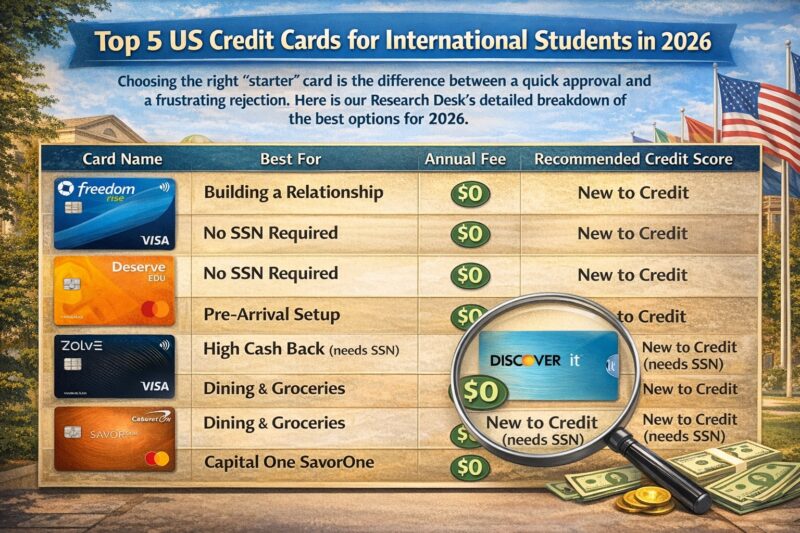
Choosing the right “starter” card is the difference between a quick approval and a frustrating rejection. Here is our Research Desk’s detailed breakdown of the best options for 2026.
1.Chase Freedom Rise®: The “Big Bank” Gateway
Why it’s a must-have: This card was specifically designed by Chase to help people with no credit history enter the ecosystem.
- Eligibility: You don’t need a credit score, but you increase your odds significantly if you have at least $250 in a Chase checking account.
- Pros: 1.5% cash back on every purchase; automatic credit line increase reviews in as little as 6 months.
- Cons: Harder to get if you don’t bank with Chase.
- International Student Utility: This is the best “long-term” card. Once you have this for a year, Chase is much more likely to approve you for “gold standard” cards like the Sapphire Preferred.
2. Deserve EDU Mastercard: The “No-SSN” Specialist
Why it’s a must-have: Deserve uses “Alternative Data” to approve you. They look at your I-20, your major, and your university rather than just a credit score.
- Eligibility: No SSN or ITIN required for international students.
- Pros: 1% cash back; includes 1 year of Amazon Prime Student (reimbursed via statement credits).
- Cons: No path to “graduate” to a higher-tier card within the same brand.
- International Student Utility: Perfect for the student who just landed and doesn’t have an on-campus job yet. It’s the easiest “unsecured” card to get.
3. Zolve Azpire Card: Approval Before You Fly
Why it’s a must-have: Zolve allows you to apply for a US credit card and bank account while you are still in your home country.
- Eligibility: Apply using your Passport and Visa.
- Pros: No security deposit; high approval rates; helps you have a card in hand the day you arrive.
- Cons: The credit limits can be low initially.
- International Student Utility: Eliminates the stress of arriving in the US without a payment method. It’s the ultimate “peace of mind” card.
4. Discover it® Student Cash Back: The “Rewards King”
Why it’s a must-have: Discover is famously friendly to students and offers the best rewards in the “starter” category.
- Eligibility: Generally requires an SSN or ITIN.
- Pros: 5% cash back on rotating categories (Amazon, Grocery Stores, etc.); Cashback Match™ (they double all rewards earned in the first year).
- Cons: Discover is not as widely accepted internationally as Visa or Mastercard.
- International Student Utility: Best for the student who wants to save money on daily living expenses like groceries and gas.
5. Capital One SavorOne Student: The Social Butterfly
Why it’s a must-have: If you spend your money on food and fun, this card is unbeatable.
- Eligibility: “New to Credit” friendly; requires a US address.
- Pros: 3% cash back on dining, entertainment, and grocery stores; no foreign transaction fees (great for traveling home).
- Cons: Requires a “hard pull” on your credit, which can temporarily lower your score.
- International Student Utility: The lack of foreign transaction fees makes this the perfect card to keep for when you go back home for summer break.

Common Questions About Getting Your First US Credit Card
- Can I get a US credit card before I arrive in the USA?
Yes, through fintech partners like Zolve or Nova Credit, which can use your home country’s credit history (from India, Mexico, UK, etc.) to approve you for a US card before you land.
- Does a foreign credit card help build my US credit score?
No. Credit systems are national. Your “perfect” score in London or Delhi does not exist in the eyes of the US bureaus unless you use a bridge service like Nova Credit.
- What is the “Credit Utilization Ratio”?
It is the percentage of your total credit limit that you are using. If your limit is $1,000 and you owe $200, your utilization is 20%. Keeping this under 10% is the fastest way to a high score.
- Is there an annual fee for student credit cards?
Most “Starter” and “Student” cards (like Chase Freedom Rise or Discover it Student) have $0 annual fees. Avoid cards with high fees for your first card.
- What is the difference between an SSN and an ITIN?
An SSN is for those authorized to work. An ITIN (Individual Taxpayer Identification Number) is for those who aren’t eligible for an SSN but need to file taxes or open interest-bearing accounts. Both can be used to build credit.
- Can I apply for a “Premium” card (like Amex Platinum) immediately?
It is not recommended. Premium cards usually require a “thick” credit file (1–2 years of history). If you apply too early, you will likely be rejected, resulting in a wasted hard inquiry.
- What happens to my credit score if I leave the US?
Your score stays in the system. If you return 5 years later, your history will still be there. However, if you leave with unpaid debt, it will haunt your record and could even affect future visa applications.
- Does “Debit Card” usage build credit?
No. Debit cards use your own money. Credit cards use the bank’s money. Only “credit” accounts report to the bureaus.
- Should I close my first card once I get a better one?
No! The “Length of Credit History” is 15% of your score. Closing your oldest card makes your “credit age” younger, which can lower your score. Keep it open, even if you don’t use it often.
- How long does it take to get a “good” credit score (700+)?
With perfect on-time payments and low utilization, most international students can reach a 700+ score within 6 to 9 months of getting their first card.
Final Thoughts: Play the Long Game
Getting a US credit card is your first major step toward financial independence in America. It’s about more than just shopping; it’s about proving you are a responsible member of the economy.
Treat your first card with respect. It is a tool that will eventually help you buy a home, start a business, or travel the world for free using reward points.
Welcome to the US, and happy building!
********
About the Author – Alen Vi
Alen Vi is a seasoned financial expert with over 10 years of experience specializing in the credit card industry. Throughout his career, he has worked with various leading media firms, providing in-depth analysis, insights, and guidance on personal finance, credit card rewards, and smart spending strategies. At Credit Card Views, Alen combines his extensive knowledge and practical expertise to help readers make informed decisions, maximize their cash back and rewards, and navigate the complex world of credit cards with confidence.
Disclaimer
The information provided on Credit Card Views is for general informational and educational purposes only and is not intended as financial, legal, or professional advice. While we strive to provide accurate and up-to-date information about credit cards, rewards programs, fees, and offers, terms and conditions can change frequently, and we cannot guarantee the accuracy, completeness, or timeliness of all content.
Credit card offers and eligibility criteria vary by issuer, credit score, and individual circumstances. Before applying for any credit card or making financial decisions, readers should conduct their own research and consider consulting with a qualified financial advisor.
Trust & Affiliate Disclosure
CreditCardViews.com provides independent and expert guidance to help you make informed credit card and financial decisions. Some links on this site are affiliate links. If you make a purchase through them, we may receive a small commission at no extra cost to you. Our recommendations are always based on research, user feedback, and expert analysis, and are not influenced by our partners. CreditCardViews.com does not issue credit cards or provide financial products directly. Final approval decisions are made solely by the issuing banks. Your trust and financial well-being are our top priority. Our platform uses SSL encryption and follows FTC, GDPR, and CCPA standards to provide secure, unbiased, and transparent credit card insights.