Written by : Daniel R. Matthews
Edited by : Credit card views Desk
Introduction — Why a US Credit Card Is Vital for F1 Students
Arriving in the United States as an F1 international student is exciting — new academic experiences, cultural exposure, and the chance to manage finances independently. However, one crucial aspect many students overlook is building a U.S. credit history.
A credit card is more than a payment tool; it is the gateway to financial independence and future opportunities, including:
- Renting apartments and securing housing
- Applying for utilities, internet, and phone plans
- Accessing loans for vehicles or personal needs
- Passing background checks for internships or jobs
The challenge: Most U.S. credit cards require a Social Security Number (SSN). Without it, many students feel blocked from entering the credit system.
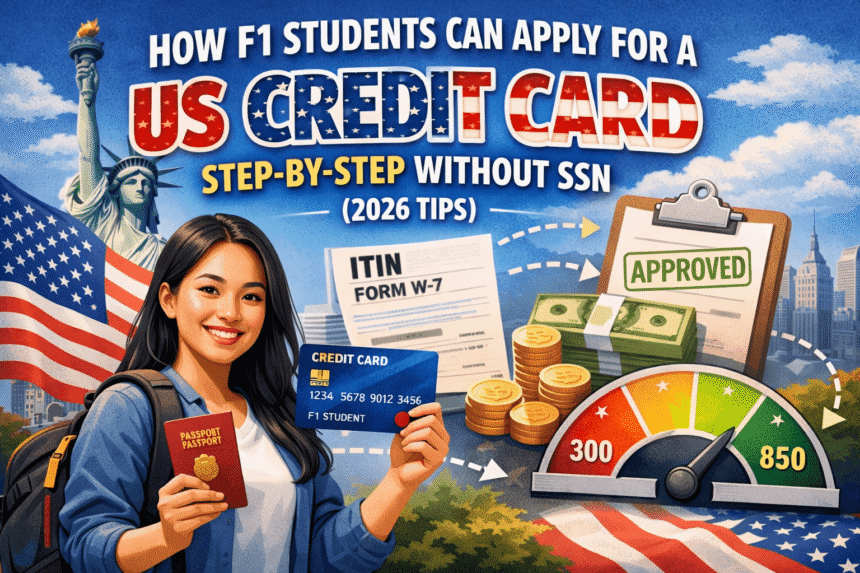
The good news: F1 students can still apply for a credit card without an SSN by leveraging ITINs, secured cards, co-signers, or authorized user options. This 2026 guide shows you exactly how.
1. Understanding Credit in the US
What Is a Credit Score?
A credit score is a three-digit number (300–850) reflecting your reliability as a borrower. Banks, lenders, landlords, and even employers use it to evaluate your financial trustworthiness.
| Factor | Impact |
|---|---|
| Credit cards | Approval and credit limits |
| Loans | Eligibility and interest rates |
| Renting | Lease approvals and deposits |
| Insurance | Premium costs |
Credit Basics Every F1 Student Must Know
| Term | Explanation |
|---|---|
| SSN (Social Security Number) | Unique number for U.S. residents, used for taxes, credit, and identity verification. |
| ITIN (Individual Taxpayer Identification Number) | Issued by IRS for those not eligible for SSN; can be used for some credit card applications. |
| Credit Bureau | Agency that tracks credit history: Experian, Equifax, TransUnion. |
| Credit Utilization | Percentage of your credit used; ideally < 30%. |
| Payment History | Most important factor (~35% of your score). |
2. SSN vs ITIN: Which F1 Students Can Use?
Who Qualifies for an SSN?
F1 students can apply for an SSN if they:
- Have on-campus employment, or
- Receive CPT (Curricular Practical Training) or OPT (Optional Practical Training) authorization
What If You Don’t Qualify for an SSN?
Many students arrive without an SSN. Alternatives include:
- ITIN-based applications
- Co-signer or joint account applications
- Authorized user on someone else’s card
- Student-friendly / no-SSN credit cards
3. Step-by-Step Guide to Applying Without SSN

Step 1 — Gather Your Financial Documents
Before applying, have these ready:
- Passport (biographical page)
- I-20 Form
- Proof of U.S. address (dorm, apartment, or campus mailbox)
- U.S. bank account details
- Phone number and email
Step 2 — Open a U.S. Bank Account
A U.S. bank account is essential. Popular banks for F1 students include Chase, Bank of America, Wells Fargo, and Citibank.
Step 3 — Choose the Right Application Path
Option A: ITIN – Apply via IRS Form W-7. Builds independent history.
Option B: Co-signer – Trusted friend/family signs with you. Higher limits but shared risk.
Option C: Authorized User – Join a family member’s card. No SSN needed.
Option D: Student-Friendly Cards – Cards like Deserve EDU or Capital One Journey often accept passports.
Step 4 — Complete Your Application
Use your legal name from your passport and double-check your U.S. mailing address to reduce rejection chances.
Step 5 — Handling Rejections
If rejected, review the reason, consider a secured credit card, and reapply in 30–60 days with stronger documentation.
4. Best Credit Card Options for F1 Students (2026)
A. Secured Credit Cards
Deposit $200–$500 for an equal credit limit. After 6–12 months of responsible use, these often upgrade to unsecured cards.
B. International Student / No-SSN Friendly Cards
- Deserve EDU Mastercard
- Capital One Journey Student Card
5. Tips to Build Credit Quickly
- Always pay on time: 35% of your score.
- Keep balances low: Use less than 30% of your limit.
- Set up auto-pay: Never miss a deadline.
- Don’t close old accounts: History length matters.
6. Common Mistakes to Avoid

| Mistake | Solution |
|---|---|
| Applying for too many cards | Wait 60–90 days between applications |
| Maxing out credit | Keep utilization < 30% |
| Closing old cards | Keep old cards open to build history |
| Missing payments | Use auto-pay and reminders |
7. Original Research: What the Data Says (2026)
Timeline to Build Credit
- 6–12 months: Score becomes visible on major bureaus.
- 12–18 months: Sufficient history for apartment approvals or higher-limit cards.
Data compiled from consumer finance analyses (2026).
8. Extended FAQ Section (2026)
Yes, F1 students can apply without an SSN by using an ITIN, becoming an authorized user, applying with a co-signer, or choosing student-friendly/no-SSN credit cards.
Q2 — How long until I build credit?
Initial credit history appears in 3–6 months; a strong, reliable credit score usually develops in 12–18 months.
Q3 — Are secured cards safe?
Yes. Secured cards are widely recommended for building credit; your deposit serves as your credit limit and reduces risk.
Q4 — What is the minimum age to apply for a credit card as an F1 student?
Most U.S. banks require applicants to be 18 years or older. Some may require parental consent if under 21.
Q5 — Do I need a U.S. bank account to get a credit card?
Yes. Most issuers require a U.S. bank account to process payments and verify your address.
Q6 — Can I apply for multiple credit cards at once?
It’s not recommended. Applying for several cards simultaneously can lower your credit score. Wait 60–90 days between applications.
Q7 — How much credit should I start with?
For secured cards, deposits typically range from $200 to $500, which becomes your credit limit. Start small and increase responsibly.
Q8 — Can international student cards earn rewards?
Yes. Some student cards, like Deserve EDU or Capital One Journey, offer cash back or points, but rewards are usually modest.
Q9 — Will being an authorized user help my credit?
Yes. If the primary cardholder has a good payment history and low utilization, it can positively impact your credit score.
Q10 — What happens if I miss a payment?
Late payments can significantly hurt your score. Always set up auto-pay or reminders to avoid late fees.
Q11 — Do I need an ITIN if I already have a U.S. bank account?
Not always. You can apply for some student cards with just a passport and U.S. bank account. ITIN helps when the bank requires a taxpayer ID.
Q12 — Can F1 students get credit cards before arriving in the U.S.?
Some companies offer pre-arrival student cards, like Deserve EDU, but options are limited. Most F1 students apply after opening a U.S. bank account.
Q13 — How can I increase my credit limit?
Use your card responsibly, pay balances in full, and after 6–12 months, request a limit increase or upgrade to an unsecured card.
Q14 — Will applying for a credit card affect my visa status?
No. Credit card applications do not impact F1 visa status. They only affect your credit report.
Q15 — How do I check my credit score as an international student?
You can check free credit reports from Experian, Equifax, or TransUnion. Some banks also provide monthly credit score updates in your online banking portal.
9. Real-Life Example: ITIN Journey
One student arrived on an F1 visa, applied for an ITIN using Form W-7, and opened a Bank of America checking account. By starting with a $300 secured card and paying it in full monthly, they achieved a 720 credit score in just 8 months.
Final Thoughts
Getting a U.S. credit card as an F1 student without an SSN is entirely achievable. By staying disciplined, paying on time, and using the resources available in 2026, you can lay a strong financial foundation for your future in the United States.
*******
About the Author – Daniel R. Matthews
Daniel R. Matthews is a credit card expert and senior contributor at CreditCardViews.com, specializing in U.S. credit cards, beginner-friendly products, and credit-building strategies. He analyzes credit cards based on approval requirements, fees, rewards, and long-term value, helping readers make informed financial decisions. Daniel focuses on clear, unbiased guidance designed to support first-time applicants and responsible credit use.
Disclaimer
The information provided on Credit Card Views is for general informational and educational purposes only and is not intended as financial, legal, or professional advice. While we strive to provide accurate and up-to-date information about credit cards, rewards programs, fees, and offers, terms and conditions can change frequently, and we cannot guarantee the accuracy, completeness, or timeliness of all content.
Credit card offers and eligibility criteria vary by issuer, credit score, and individual circumstances. Before applying for any credit card or making financial decisions, readers should conduct their own research and consider consulting with a qualified financial advisor.
Trust & Affiliate Disclosure
CreditCardViews.com provides independent and expert guidance to help you make informed credit card and financial decisions. Some links on this site are affiliate links. If you make a purchase through them, we may receive a small commission at no extra cost to you. Our recommendations are always based on research, user feedback, and expert analysis, and are not influenced by our partners. CreditCardViews.com does not issue credit cards or provide financial products directly. Final approval decisions are made solely by the issuing banks. Your trust and financial well-being are our top priority. Our platform uses SSL encryption and follows FTC, GDPR, and CCPA standards to provide secure, unbiased, and transparent credit card insights